Morgan's Historic District Architectural Styles & Design Guidelines

History: Morgan’s Subdivision is associated with numerous persons who had a significant influence on local Denver history.

Architecture: The district is associated with a number of prominent early Denver architects and designed with a distinctive architectural character influenced by the City Beautiful movement.

All information and photos courtesy of Landmark Preservation. 

Notable Architects

“Jules Jacques Benois Benedict was a noted and prolific Denver, Colorado based architect who was known during his lifetime as Julius, Julius B., Jules, Jacques, “Jock,” and finally J. B. He was born in Chicago, Illinois on April 22, 1879 to Martha M. Bessnoit (b.1851) and Bernhard M. Benedict (b.1850). His mother was originally from Saxon, Germany and his father was born in Austria.

In 1909, Benedict moved to Denver, Colorado where his brother, Herbert had already been working as a civil engineer since 1907. Benedict established his architectural office in the Ernest and Cranmer building at 17th and Curtis Streets. His first Denver commission, the Sunken Garden Pavilion (1910), now demolished, was located in a park near West High School. The Central National Bank Building (1910-1911), originally located at the corner of Arapahoe and 15th Street was his first commercial commission. Benedict’s designs for the structure were executed in association with his former employers from Chicago, Frost and Granger. This building is arguably that firm’s final work because the two architects dissolved their partnership in 1910. When completed, Benedict moved his architectural office to the new building and remained there for a number of years. Later, he moved his office to another commercial building he designed, the Flatiron Building (1923), once located at 1669 Broadway.

Between 1910 and 1943, Benedict designed numerous homes, churches and public buildings in Boulder, Denver, Evergreen, Golden, Littleton and in rural Douglas and Jefferson counties. Benedict’s architectural style was based on his Beaux Arts training, with stylistic and decorative influences derived from French Provincial, Italianate, Gothic and Mediterranean designs. Many of his extant buildings are listed on the National Register, State Register or designated as Denver Local Landmarks.

Benedict was married to the socially connected June Louise Brown (1883-1945) in Denver on February 20, 1912. The couple later divorced. June Benedict was the daughter of a wealthy mercantile owner, Junius Flagg Brown. To complement Benedict’s lithographs of architectural fantasies, usually sent to friends at Christmas, June Benedict wrote poetry and also signed her work as J. B. B. or J. B. Benedict. The couple had two children: Peter N. Benedict (1914-1983) and an adopted daughter, Ursula Benedict McPhee (1920-1949). The family lived on a 90-acre parcel of land in Littleton that had originally been part of the Gallup ranch. The Benedicts’ large mansion, once known as Wyndmere Farm, remains at the intersection of West Caley Avenue and South Datura Street. It is currently used as a convent for the Carmelite Order. Although a lifelong Episcopalian, during his final illness Benedict converted to Catholicism before his death in Denver on January 16, 1948. J. B. Benedict is buried in Mount Olivet Cemetery.”

Courtesy of Denver Public Library

901 York – Ruth Porter Waring House, currently the Denver Botanic Gardens Administration Building. 

918 York (1924)

910 Gaylord (1922)

800 Race (1920)

801 Race (1926)

817 Race (1924)

2205 East 8th (1926)

District Layout & Composition

The streets are laid out on a north-south and east-west grid, with north-south alleyways. Cheesman Park serves as the district’s western boundary and the Denver Botanic Gardens as the northern boundary. The district has moderately wide asphalt streets with low curb profiles and very few historic curb cuts.

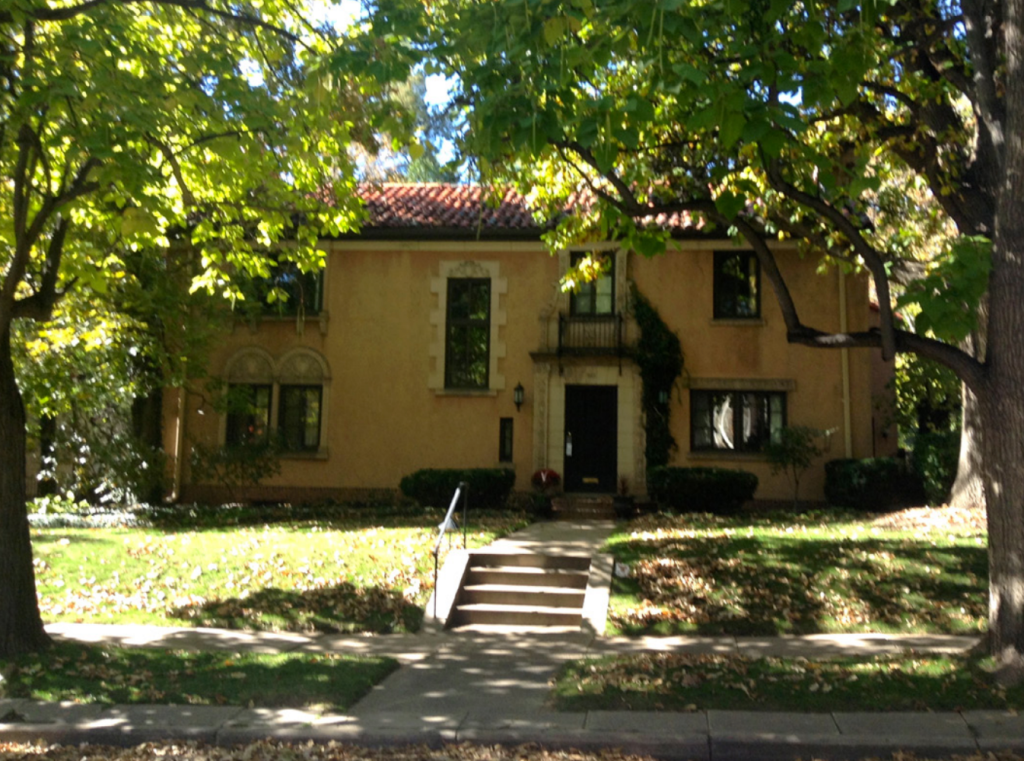
The district features wide modern concrete sidewalks separated from the street with a tree lawn and mature trees. Occasionally, there are discontiguous sections of secondary, smaller sidewalks that abut the curb.

Historically residential.

The district contains a combination of square and rectangular lots. On the rectangular lots, the narrow, smaller side fronts the street.

Generally, buildings front onto the north-south streets with the exception of some structures on E. 8th Avenue and E. 9th Avenue, which front the east-west streets.

The lots are predominantly sloped throughout the district, with occasional at-grade lots. Within each block, there is generally a uniform front yard setback, with a moderate to large front yard setback on the north-south streets. The structures located on the north side of E. 9th Avenue are characterized by larger yards and setbacks on the front and sides with relatively small rear yards, as the structures are adjacent to Cheesman Park and the Denver Botanical Gardens.

1. REPRESENTS A TYPICAL STREETSCAPE WITHIN MORGAN’S SUBDIVISION WITH A SLOPED LARGE FRONT YARD AND WIDE PEDESTRIAN SIDEWALK SEPARATED FROM THE STREET WITH A TREE LAWN AND MATURE TREES. NOTE THE SLIGHTLY ATYPICAL SMALLER SIDEWALK ABUTTING THE CURB.​

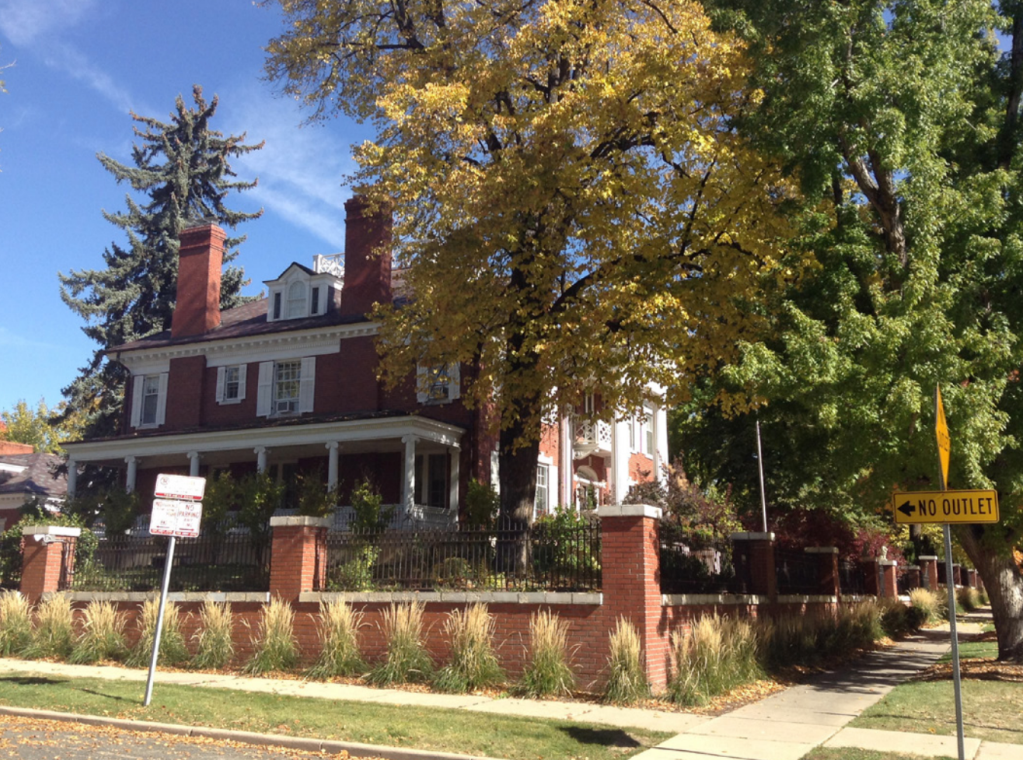
2. This square corner lot has a large front and side yard with mature trees. Note the historic type of fencing typically found in the district.

Design Review

All properties within a historic district are subject to design review. When planning a preservation or construction project, it is important to consider the character-defining features of the district.

When reviewing proposed changes to a property, the Denver Landmark Preservation Commission uses the Design Guidelines for Denver Landmark Structures & Districts in combination with the character defining features of the historic district to evaluate the project’s compatibility with the property and historic district.

The character-defining features document for each district generally captures the most prevailing architectural and site features found within the district. In some instances, a structure and site within a district may be the exception to the character-defining features.

Primary Buildings

Building Height: Predominantly two- to three-stories in height.

Building Shapes: Large single-family residences with boxy, generally symmetrical massing.

The most predominate materials are red brick and stucco.

Hipped, gable, and cross gable forms are the most common roof types. Historically barrel tile clay roofs, slate, or cedar shingles were common.

Gable and hipped dormers are found on the front and sides of Classical Revival style buildings and occasionally on Tudor and Denver Square style buildings.

Central entries are very common within this district; however, there are a small number of off-set side entries, particularly on Tudor style structures. Arched entry doors and doors with side and fanlights are common. Simple wood panel doors are often found in the district, some, with lights in the upper portion.

Divided light, double-hung wood windows are common throughout the district. Paired windows, arched windows, leaded glass and diamond-pane windows are found throughout the district. Dormer windows are also common. There are frequently symmetrical window bays along the façade. Windows are often characterized by stone sills and decorative headers, with a jack arch or a keystone element.

While the district is generally characterized by a lack of porches, portico stoop entries and simple arched entryways are common. Numerous different types of Classical pediments are found throughout the district, including broken pediments, arched pediments, bracket-supported pediments, and Classical double porticos. However, a small number of homes feature front and/ or side porches. Those porches, when present, generally extend the full width along the building façade with either masonry foundation and piers, or wood foundations and columns. Hipped roofs are common for porches.

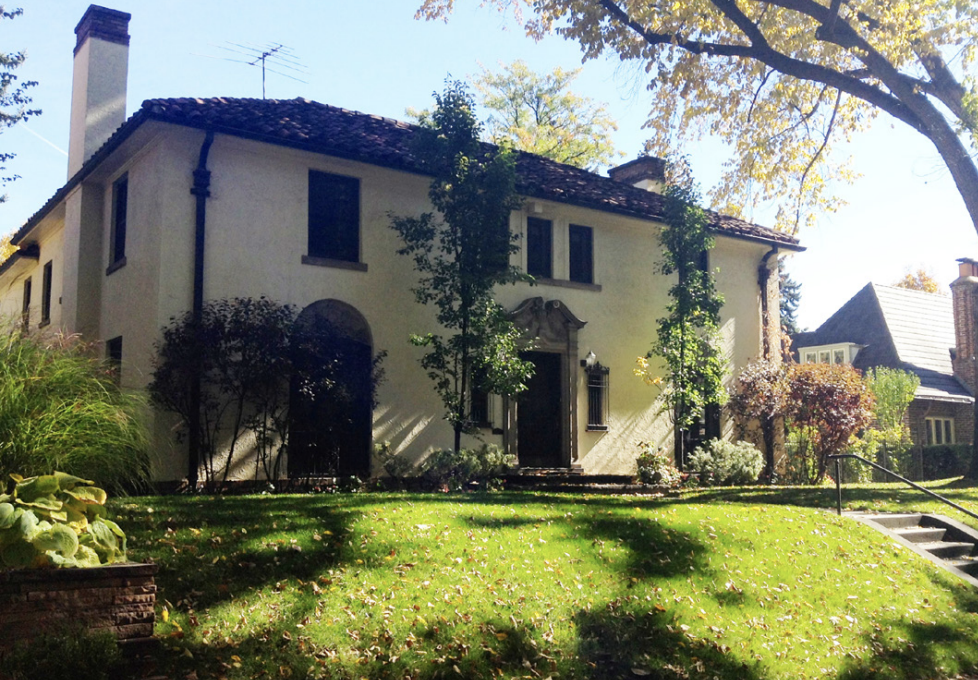
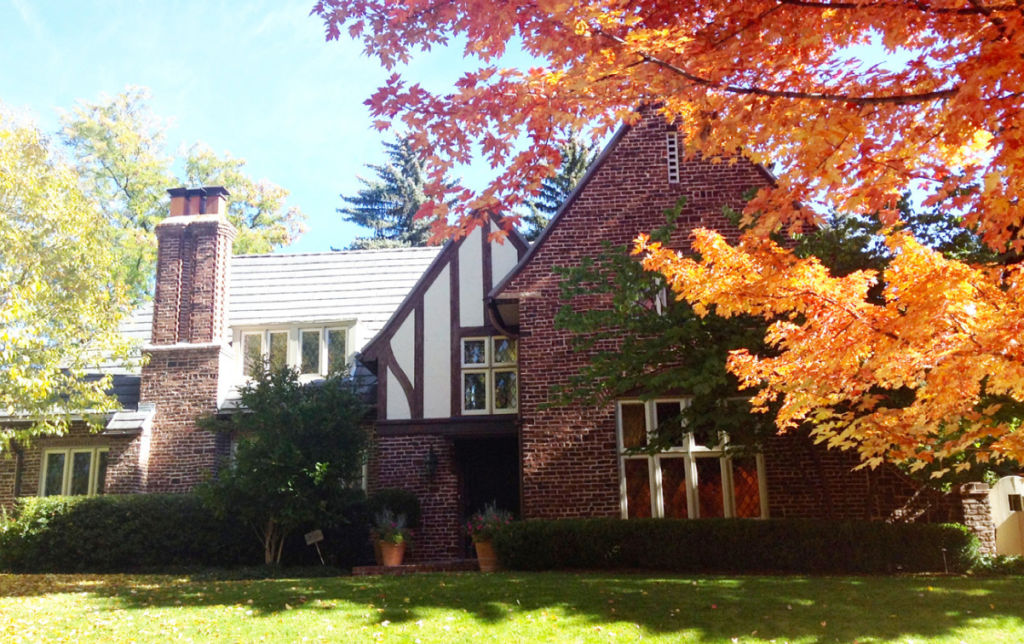
Nearly all the structures are high-style with the typical ornamentation of each style. Classical ornamentation, including symmetrical facades, dentils in the cornice and Classical orders are commonly found on the Classical Revival style houses. The Tudor Revival style houses typically are asymmetrical, with exposed half-timber, steeply pitched roofs, and cross gables. On the Mediterranean Revival style houses, stucco facades, arched windows, and lower pitched roofs with barrel tile clay are typical. A Denver Square with Craftsman ornamentation and a Prairie influenced house both have horizontal lines, overhanging eaves, and offset or side entrances. Decorative chimneys are common throughout the district.

3. The Denver Square style residence with Craftsman ornamentation illustrates the boxy massing and the common red brick construction found throughout the district. While generally they have central entrances and no porches, note the full width porch and offset entry.

4. This Mediterranean Revival style structure has a stucco façade, a low-pitched barrel tile clay roof, and a central entry with decorative pediment, symmetrical window bays, and multiple chimneys.

5. This Classical Revival style structure has the typical red brick construction, symmetrical façade, triangular pediment surrounding the central entry, and dormer windows in the gable roof.

6. Note the asymmetrical massing with an offset entry, the red brick construction with stucco and timber framing accents, the decorative chimney, and the leaded glass casement windows on the Tudor Style structure.

7. The Classic Revival style structure with a large central walkway to the portico entry is typical. Note the historic fenced in front yard with masonry foundation, concrete coping, and iron fence above.

Accessory Structures & Site Features

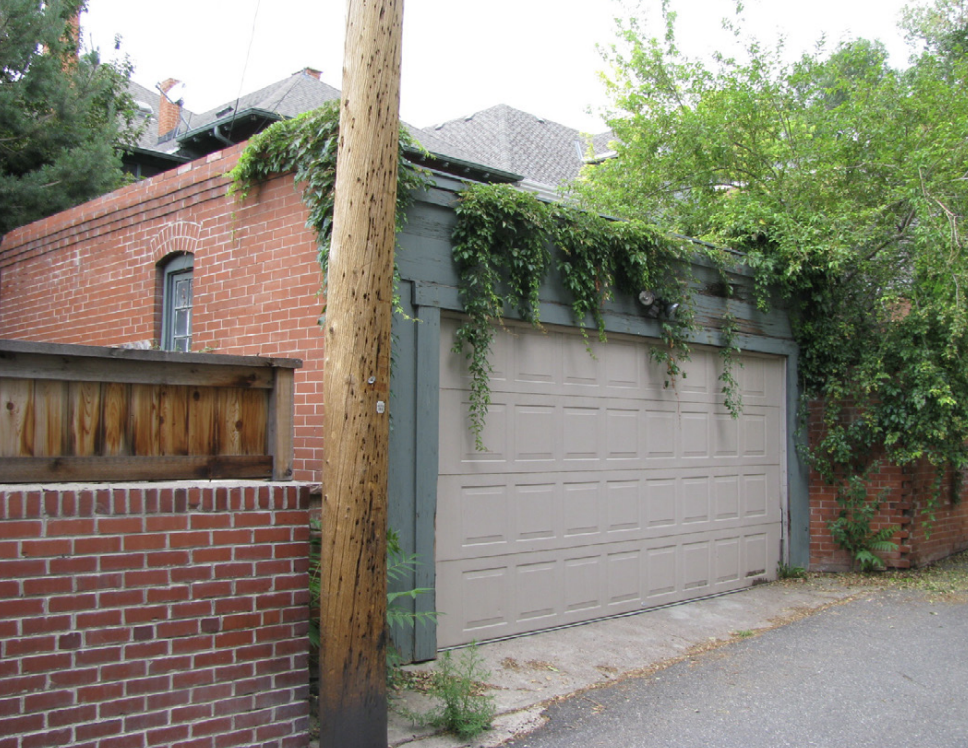
Detached: Yes, nearly half the structures feature detached garages. Generally, the remainder of properties have attached garages.

Access: The garages predominantly face the alleyway; however, a small number face the street.

Height: Both single and multi-story garages are found within the district.

Size: Generally, the garages are small to moderate in size and could fit one or two cars. 

Shape: While some attached garages are incorporated into the architecture of the primary structure, the remainder of both attached and detached garages are typically boxy, rectangular shapes with flat roofs with parapets, hipped roofs, or gable roofs. 

Materials: The garages generally match the material and style of the primary residence.

Front Yards: Front yards are typically fairly large, often enclosed with historic fences. The fences typically have masonry, brick, stone, or stucco foundations and piers with open cast iron fencing above. Concrete coping often cap the brick foundations and piers.

Side & Rear Yards: The size of yards varies depending on the configuration of lot. The square lots generally have larger side yards and the smaller, rectangular lots typically have small side yards. Side and rear fencing is prevalent, often made of brick and iron. Non-historic wood fencing is frequently found enclosing rear yards along the alley.

Retaining Walls: Historically, the front and side yard fences often incorporate retaining walls. A small number of historic concrete or concrete block retaining walls are found within the district.

The walkways are often wide, four to five feet, and frequently have a number of steps to accommodate the front yard slope. There is a variation in materials, with sandstone pavers and nonhistoric concrete or brick pavers.

8. This detached garage has roof and parapet, red brick construction that matches the primary residence, and alleyway location is typical.

9. This alley-facing attached garage mimics the roof line and brick cladding of the primary residence.